
What is the “Window of Tolerance”?

Exploring Dan Siegel’s theory of emotional regulation
What is the window of tolerance?
The “Window of Tolerance” is a simple yet powerful psychological model used to help us understand how our nervous system responds to stress. Originally developed by psychologist Dr. Dan Siegel, it describes the zone in which we feel calm, balanced, and able to cope with everyday life.
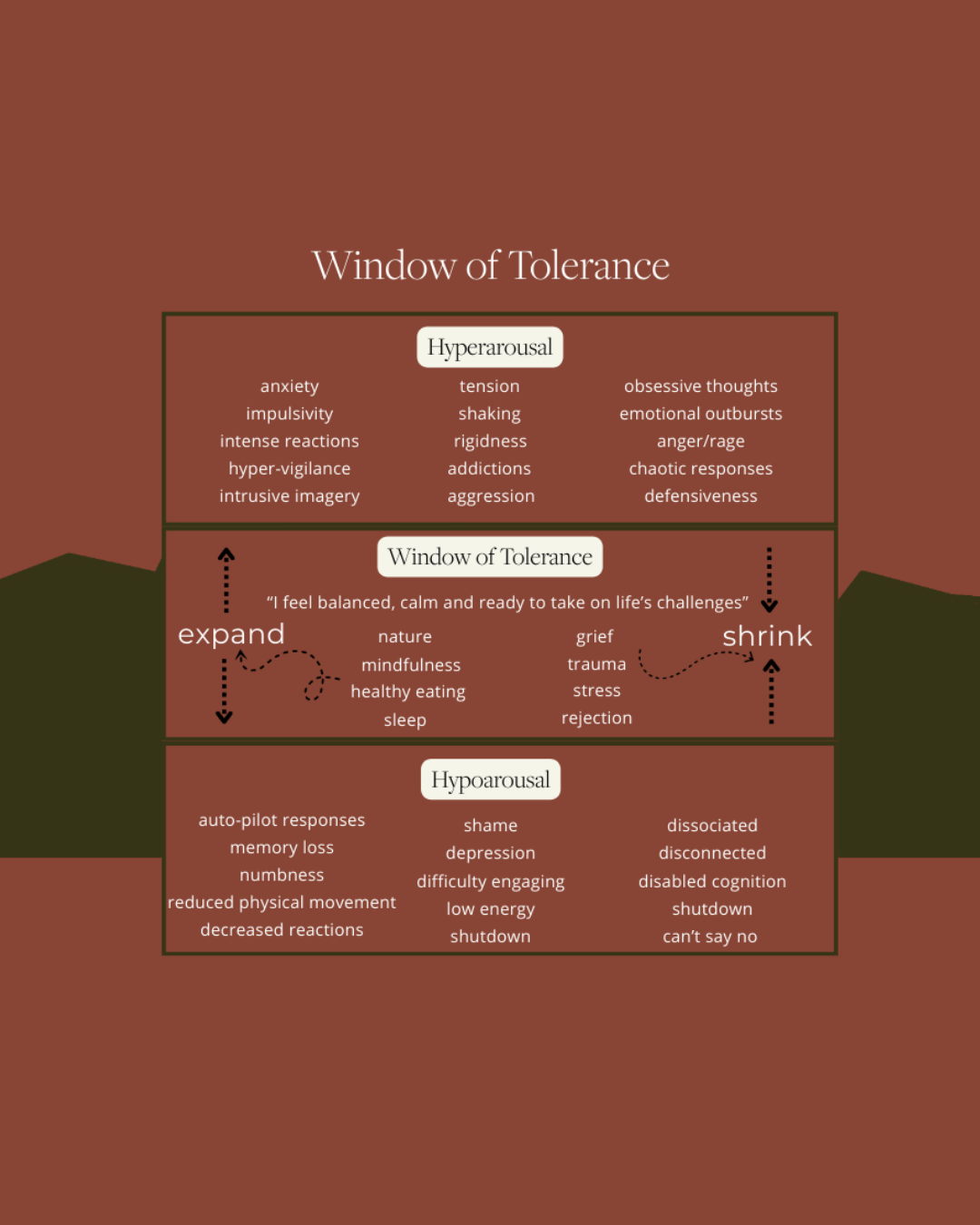
When we are “within our window” we feel calm, collected and curious. We can think clearly, regulate our emotions, and respond to challenges in a grounded way. We might still feel stress, sadness, or frustration—but these emotions feel manageable, and we can tolerate them.
When life becomes overwhelming, however, we can move outside this window in two main ways:
Hyperarousal (above the window) – sometimes known as our “fight or flight” response; in this state we might feel anxious, panicked, irritable, or “on edge”
Hypoarousal (below the window): sometimes known as our “freeze or flop” response; in this state we might feel numb, disconnected, shut down, or exhausted.
What’s the science?
It’s important to remember that our nervous system responses aren’t flaws—they’re protective survival mechanisms.
If we grew up in a household where chaos and shouting were the norm, for example, our nervous system might have learnt to keep us safe and “check out” by disconnecting.
Similarly, if we grew up in an environment that was volatile or unpredictable, our nervous system might have learnt to stay hypervigilant and on “high alert”, ready to face the next problem or danger.
These responses are simply an example of how our nervous system tries to keep us safe at all costs, and they can be heightened and more severe if we’ve experienced a particular stress or trauma in the past.
The size of our window of tolerance can vary from person to person. As well as past experiences, factors like current stress levels, sleep, and support systems all have their role, too. When we’re overwhelmed or burnt out, our window often becomes narrower. This means it takes less time to push us out of balance, and more time to come back into balance.
The good news is that we can learn to widen our window of tolerance over time. Simple somatic practices like mindful breathing, movement, grounding exercises and supportive relationships can all help our nervous system feel safer and more regulated.
Learning to widen our window can sometimes feel like learning to flex a new muscle, though – it takes time, and it can feel hard and uncomfortable at first.
In therapy, mapping what pushes us in and out of our window of tolerance can be a helpful place to start. From there, we can begin to recognise when we’re becoming overwhelmed, explore what might be driving this and respond with care rather than self-criticism.
How to map your window of tolerance
Below you’ll find a few simple journalling prompts to help you map your window of tolerance.
What does it feel like when I’m within my Window of Tolerance?
Example: “I feel steady. My breathing is normal, my shoulders drop a bit, and I can think through things instead of reacting. I still have emotions but they don’t bowl me over. I can make decisions, send emails, and be around people without feeling overwhelmed.”
What signs show me I’m moving above the window (hyperarousal)?
Example: “I notice my chest gets tight. My mind races, I jump between tasks, and everything feels urgent. I get snappy or overly apologetic. I might check my phone a lot or speak quickly. It feels like I have to ‘fix’ something immediately.”
What signs show me I’m moving below the window (hypoarousal)?
Example: “I go quiet. My body feels heavy, slow or frozen. I stare into space, lose track of what I’m doing, or feel disconnected from myself. It feels like I’m under water or watching life from the outside.”
What tends to push me out of my window?
Example: “Too many plans in one day, conflict with people I care about, big work deadlines, not enough sleep, or when someone is upset with me. Even small unexpected changes can tip me over if I’m already stressed.”
What helps me come back into my window?
Example: “Slow breathing, grounding my feet on the floor, placing one hand over my heart or going for a quick walk outside. Connecting to others by talking to someone supportive, playing with my dog or even watching a funny TV show can also help.
