
An Introduction to Internal Family Systems (IFS)

Building a relationship with our inner world
What is Internal Family Systems (IFS)?
Originally developed by psychotherapist Dr. Richard Schwarz, IFS is a gentle and compassionate therapy model that suggests we are all made up of multiple different “parts” – like anxious parts, perfectionist parts or sabotaging parts. This might sound strange when we are so used to thinking of ourselves as one solid, unified being – but from a nervous-system and developmental lens, seeing ourselves as a system of different parts actually makes a lot more sense.
What is a “part”?
In IFS, a “part” is simply a felt experience – an inner voice, a physical sensation, a behaviour pattern or recurring feeling that has some consistent role in how we respond to life. These parts aren’t literal little people in our head — they’re aspects of us born from our history, especially experiences in childhood where we learned that a certain way of being helped to keep us safe. They’re adaptive strategies, not flaws – each part of us exists for a reason, and each has its own feelings, fears and needs.
Getting to know our inner system
Some parts try to keep us safe by planning, controlling, or criticising; in IFS therapy we call these parts “managers”. Other parts step in by shutting us down when something painful pops up; numbing, distracting or soothing us in ways that might feel impulsive – these parts are known as “firefighters”. Both “managers” and “firefighters” are known as “protectors”, and beneath these protectors are often more vulnerable ones carrying old pain, fear or grief that has been pushed away – these parts are known as “exiles”.
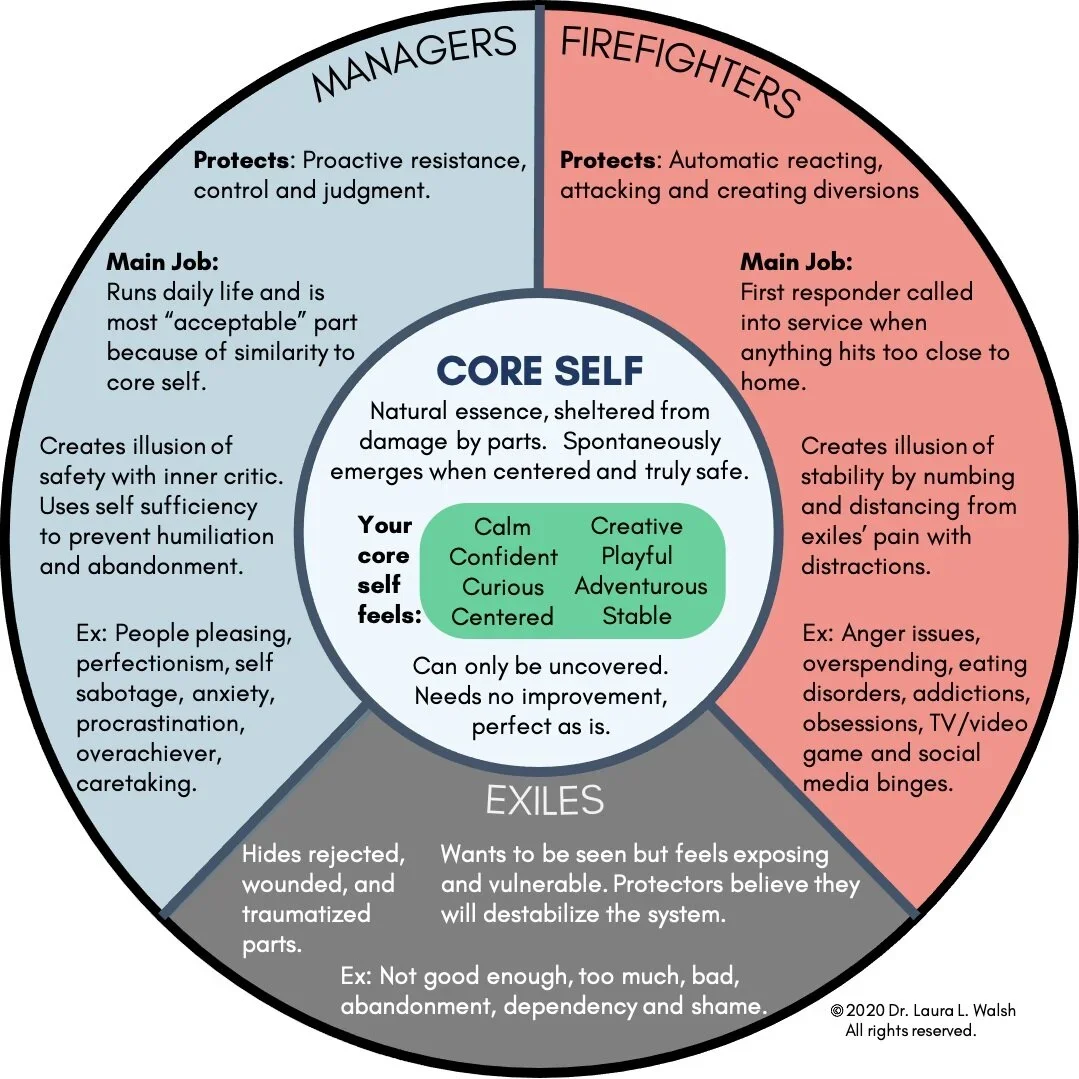
Building compassion
One of the most transformative shifts we can make is learning to say “a part of me feels this way” rather than “I am this way”. This subtle change creates space – inviting curiosity over self-judgement, and compassion over blame.
In IFS therapy, we learn to approach all of our parts with curiosity rather than judgement by listening to what each has to say, and building a relationship with them from a calm, grounded place in the here and now. This calm, grounded energy is known as the “Self” or “self energy”.
Meeting the “Self”
This is the calm, compassionate part of ourselves that isn’t actually a “part” at all – it’s our core. Self energy is the electricity that runs through our entire system – the place inside us that can observe thoughts and feelings without being overwhelmed by them. When we’re experiencing “self energy” we naturally feel qualities like curiosity, clarity and confidence – we feel more connected, both with ourselves and others – and we’re able to approach life’s challenges with more courage and creativity.
Unburdening our parts
From this calm, compassionate space, our Self can gently connect with our exiled parts – discover what they’re trying to protect us from, and guide our inner system with more kindness.
What feels like inner conflict – such as opposing wants, repetitive patterns or emotional intensity – can be gently reframed as parts trying to help and protect us, in the only way they know how. Once parts begin to feel seen and heard rather than shut down or dismissed, they often become less extreme, more cooperative, and more at ease.
IFS isn’t about getting rid of parts – it’s about helping our parts feel more understood, allowing them to trust our self energy to lead the way, thus resulting in more harmony within our inner world.
