
Time Management Strategies for ADHD

Tools and compassionate practices for finding focus with ADHD
A philosophy for time management
At its heart, time management is an act of free will. It is the decision to serve the future rather than the present — to pursue goals that cannot be completed in a single moment, and to keep making choices that honour that intention even when the present is loud and insistent. Most of us, most of the time, are simply responding to whatever stimulus arrives next: a notification, a thought, a feeling, a more interesting thing glimpsed out of the corner of the mind.
This is why the question why am I doing this? is so quietly radical. Before allowing yourself to be pulled into a new task or distraction, pausing to ask what goal you are actually serving in this moment is an act of internal rather than external control — a choice to be the author of your attention rather than its passenger.
Executive functions are the mechanism through which intentions become actions. They are the bridge between knowing what you want to do and actually doing it — and for most people, they operate largely beneath conscious awareness. But they can be brought into the light. Developing a relationship with your own executive functions — noticing when they are working, when they are failing, and what conditions help them operate — is one of the most genuinely transformative things a person with ADHD can do. Not because it fixes anything, but because awareness is always the beginning of choice.
Time management is one of the most quietly exhausting challenges of living with ADHD — and one of the most misunderstood. Managing our time with ADHD can often feel like we’re trying to move mountains – it can look like lateness, missed deadlines, or a chronic inability to estimate how long things take. But underneath those surface behaviours is something more fundamental: a genuinely different relationship with time itself.
“The ADHD Brain tends to experience time in two tenses: now and not now” Russell Barkley
The Science
Time management in the brain is handled by the prefrontal cortex, which is responsible for prospective thinking — mentally projecting yourself forward in time, simulating future scenarios, and treating them as real enough to act on. In ADHD, reduced prefrontal cortex activation means the future doesn't get adequately "rendered," which is why it remains foggy until it becomes the present.
For people with ADHD, time tends to collapse into two states: now and not now. This is what researchers call future myopia — a shorter time horizon than would be expected for someone's age, one that typically continues developing well into the thirties. Future events simply don't hit the radar until a deadline moves close enough to feel present. The result is a familiar and painful cycle: apathetic drifting while something feels far away, then frantic scrambling once it finally arrives in the now. Planning ahead isn't a matter of effort or intention — the future genuinely isn't visible yet.

This is shaped in part by what's known as the time horizon — how near something needs to be before a person feels moved to act on it. For ADHDers, this horizon is strongly influenced by interest and motivation. Highly desirable tasks, or consequences that feel genuinely immediate, come into view earlier. So does the presence of another person — which is why body doubling is one of the most effective and underrated tools available. The time horizon can't always be stretched by willpower, but it can be activated by the right conditions.
Underlying all of this is temporal discounting — the psychological principle that the further away a reward or consequence is, the less weight it carries in the present moment. The siren song of now is loud for everyone, but for people with ADHD it is louder still. What looks like poor judgment to others — choosing immediate comfort over future benefit — is often a reasonable decision made on the basis of what is actually felt and perceived right now. Past experience doesn't reliably shift this. Neither do guilt-inducing lectures about what should have been done sooner. The key is to make the future feel present.
Practical Strategies
Find a planning tool that works for you
Schedules vs to-do lists – schedules are for time-specific tasks while to-do lists are for non time-specific tasks. Both are important
Keep it simple – the ADHD brain is susceptible to what might be called planner romanticism — the pleasure of buying a beautiful notebook or designing an elaborate system. Resist the pull toward complexity. The best planner is the one you actually use
Stay flexible – rigidity rarely serves the ADHD brain. Build in regular moments to re-adjust — to speed up, reduce scope, change course, or simply acknowledge that circumstances have shifted. The goal isn't a perfect system. It's a responsive one
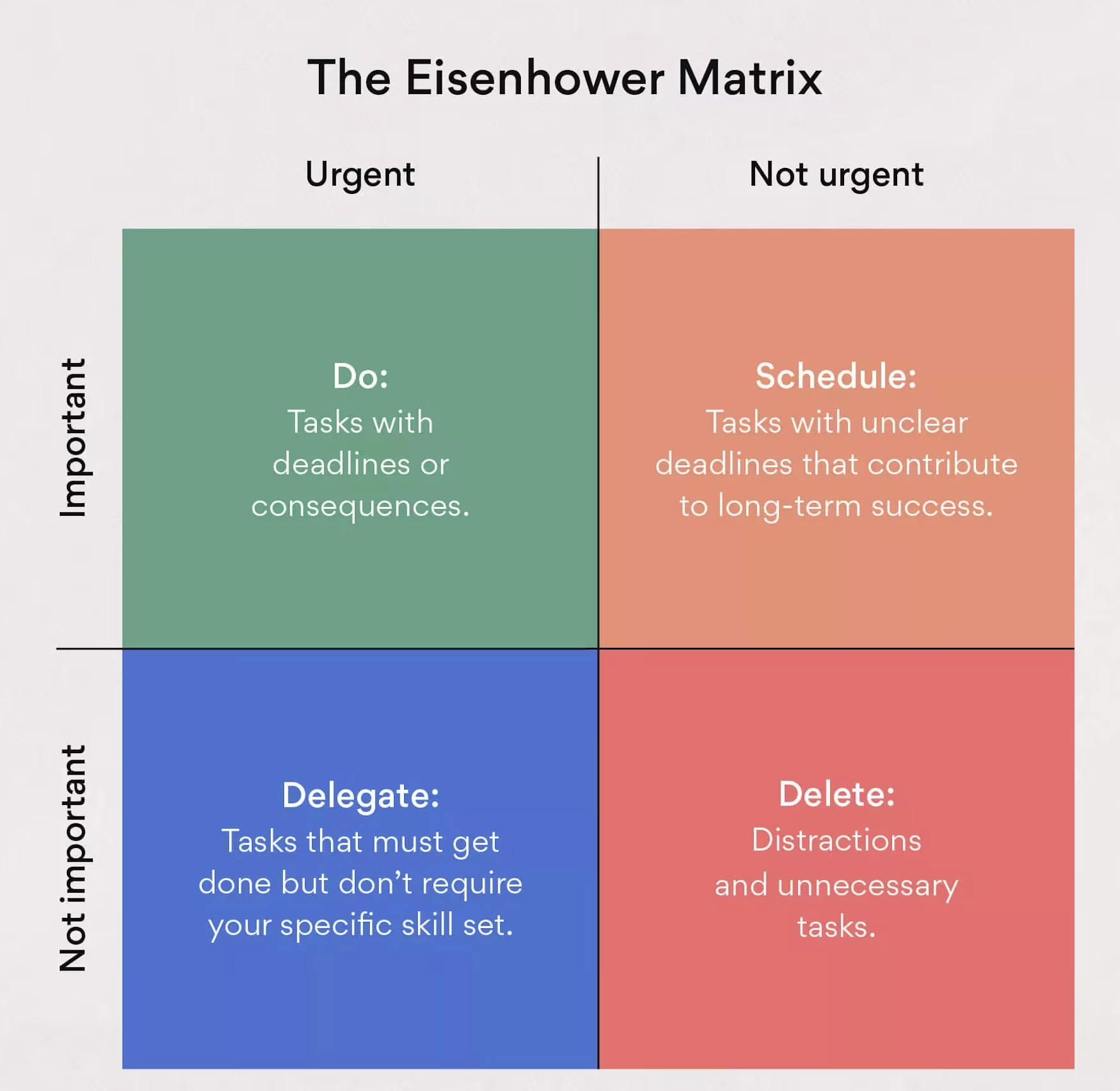
The Eisenhower Matrix — sorting tasks by urgency and importance is a useful tool for cutting through the noise when everything feels equally pressing or equally unimportant. Urgent and important goes first. Important but not urgent gets scheduled. Urgent but not important gets delegated where possible. Neither urgent nor important gets questioned
Curate your environment
The ADHD brain is exquisitely sensitive to its surroundings — every notification, interruption, or piece of visual noise draws on a finite pool of attentional resource. Think about your signal-to-noise ratio: what genuinely needs to be in your environment, and what is just competing for your attention?
Pre-empt distractions – turn off notifications on your phone
Reduce visual noise – clear your space of clutter
Make time concrete – place several clocks around the house
Make the future feel present
Because the ADHD brain lives so powerfully in the now, one of the most effective strategies is to artificially drag the future closer. Some ways to do this:
Set early reminders – create personal deadlines before the real one creeps up
Create artificial consequences – External accountability brings the future into the now – tell a friend you’ll buy them dinner if you’re late or ask your manager for more frequent check-ins
Work with time directly
Predict, then test – Before a task, estimate how long it will take. Then time yourself. Most people with ADHD will find they are consistently optimistic. Once you know your patterns, build in a buffer before and after each event including travel and transition time
Pomodoro technique – working in focused blocks of 25 minutes with short breaks between works well for many ADHD brains because it makes time feel chunked, manageable, and concrete. It also creates a rhythm of stopping and checking in, which supports the kind of dynamic attention regulation that doesn't come naturally. Ask yourself regularly: should I shift task, or stick to this?What goal am I fulfilling by sticking to this task? That question alone can interrupt the drift into hyperfocus or avoidance
Break down tasks – The more granular you can make something, the more likely it is to feel actionable in the present moment
Journalling Prompts
Looking back: lessons from your own story
What patterns do you notice around time in your life? Are there particular times of day, types of task, or kinds of situation where things tend to go wrong?
What has the experience of being late, unprepared, or overwhelmed by time cost you — practically, relationally, emotionally?
What stories have you told yourself about what those experiences mean about you?
Looking forward: imagining a different relationship with time
How would it feel to arrive somewhere early, or comfortably on time? Sit with that for a moment. What is the texture/colour/image/sound of that feeling?
What would you like to feel when you're on your way somewhere, running on time — in your body, in your mind?
What would it mean for your sense of self to have a different relationship with time? Who would you be?
What is one small moment in the near future where you could practise bringing that feeling into reality?
Somatic Anchors

Use the stop sign
When you feel the pull of distraction, literally hold up your hand and say (aloud or internally) stop. This small intervention supports response inhibition, giving your executive functions just enough time to catch up
Visualise the future
Picture yourself actually doing the desired task, in a specific place, at a specific time — this helps the ADHD brain experience what it struggles to imagine abstractly
